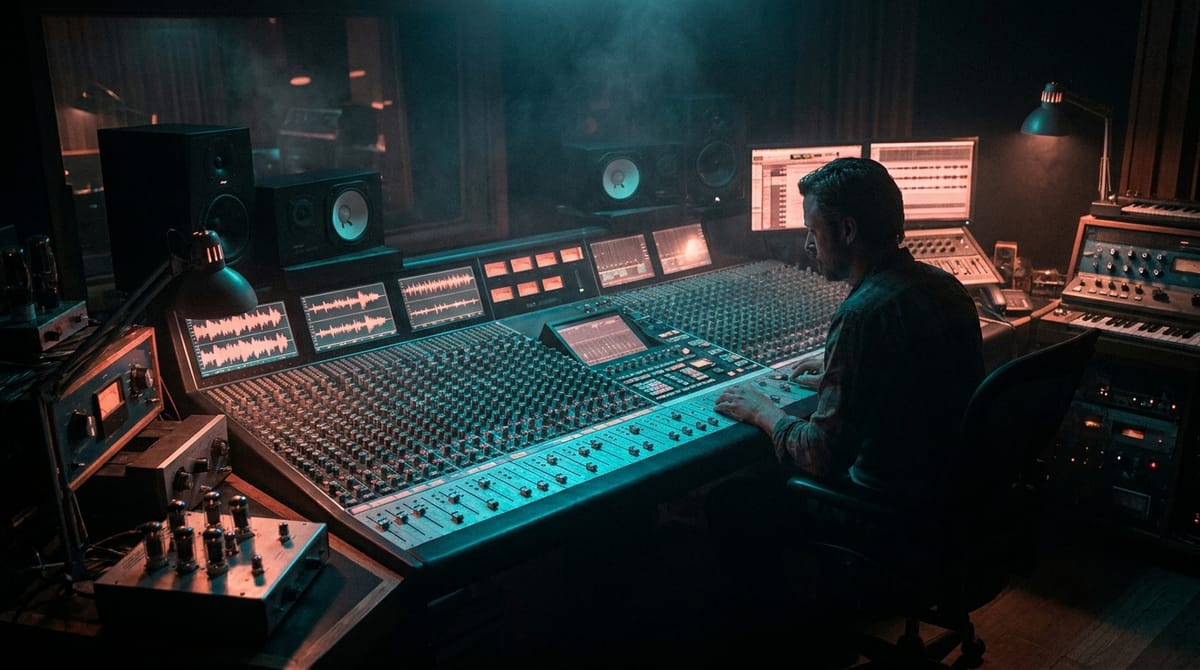
Show a generative video clip to a room of people and ask what feels off, and most will point at the picture — a hand that moves strangely, a texture that looks too smooth. They're usually wrong about the real problem. In our experience producing AI video for brands, series, and short films, the picture clears the believability bar faster than people expect. What actually sells or breaks a shot, almost every time, is the sound.
Why Picture Quality Isn't The Bottleneck Anymore
Generative video models have crossed a threshold where a well-directed, well-lit shot can hold up against real footage on a first watch. Once a picture clears that bar, spending more effort chasing marginal visual fidelity has diminishing returns. The bigger lever left on the table, for most productions, is what's happening on the audio track — and it's the layer most new AI productions under-invest in.
The Sound Stack: Voice, Score, and SFX
A believable AI production needs the same three sound layers a traditional production needs: voice performance, score, and sound effects, each doing a distinct job. Voice carries character and intention — on our productions this typically runs through Eleven Labs, tuned for pacing and emotional register rather than just clarity. Score sets emotional temperature scene to scene; we build most original scores in Suno, treating them as a directing tool rather than a background layer. Sound effects — footsteps, room tone, the small mechanical noises a space makes — are what convince an audience a generated environment is a real place with weight and texture, not a rendered backdrop.
Skip any one of these three and the gap is obvious, even to a viewer who couldn't articulate why. A gorgeous generated room with no room tone feels like a stage set. A character with a strong voice performance but no score under their big moment feels emotionally flat.
Mixing for Emotion, Not Just Clarity
A common mistake is mixing an AI production the way you'd mix a corporate explainer — optimizing purely for intelligibility, voice up front, everything else turned down to stay out of the way. That approach protects clarity and kills feeling. Score and ambient sound need room to breathe under dialogue, and silence needs to be used deliberately, the same way a director uses a held wide shot. The mix is a directing decision, not a technical afterthought handled at the end.
A Practical Sound Checklist for AI Video
Before any AI-generated sequence goes out the door, we run it against a short list: does every space have appropriate room tone, even if it's subtle? Does the score change with the emotional beat, not just play underneath the whole scene at one volume? Does the voice performance's pacing match the edit's pacing, rather than being generated in isolation and dropped in? And critically — does the mix let quiet moments stay quiet, instead of filling every second with sound out of habit?
Picture gets a project's attention. Sound is what makes people believe it, and remember it. On every production, we treat the sound pass as a second directing pass — not a finishing touch.